Executive Intelligence Dossier
GRADE A · 87/100 · BOARDREADY · RICHNESS 98/100
Public sample · complete artifact published below
The filing reads confident. The market it describes is not the one buyers can find ITC in. ITC Limited
This page is the overview. The complete engine artifact, all 148 sections, 159 embedded evidence screenshots, captured ad creatives, both board simulations, and the per-metric provenance appendix, is published in full at the link below. Nothing here is a mockup: this is what a Board Pack is, end to end, on a company with rich enough data to show every layer firing. Richness 98/100 puts this brief in the RICH band (86 and above), the only band we publish.
Overall grade
A / 87
boardReady · 0 weaknesses · richness 98/100
Generative visibility
0/100
0 of 4 buyer-intent AI answers cite ITC (measured)
Answer-engine readiness
13/100
zero FAQ/HowTo schema · zero question headings
Forensic shift
39%
auditors' report reframed YoY (measured, FY26 filing)
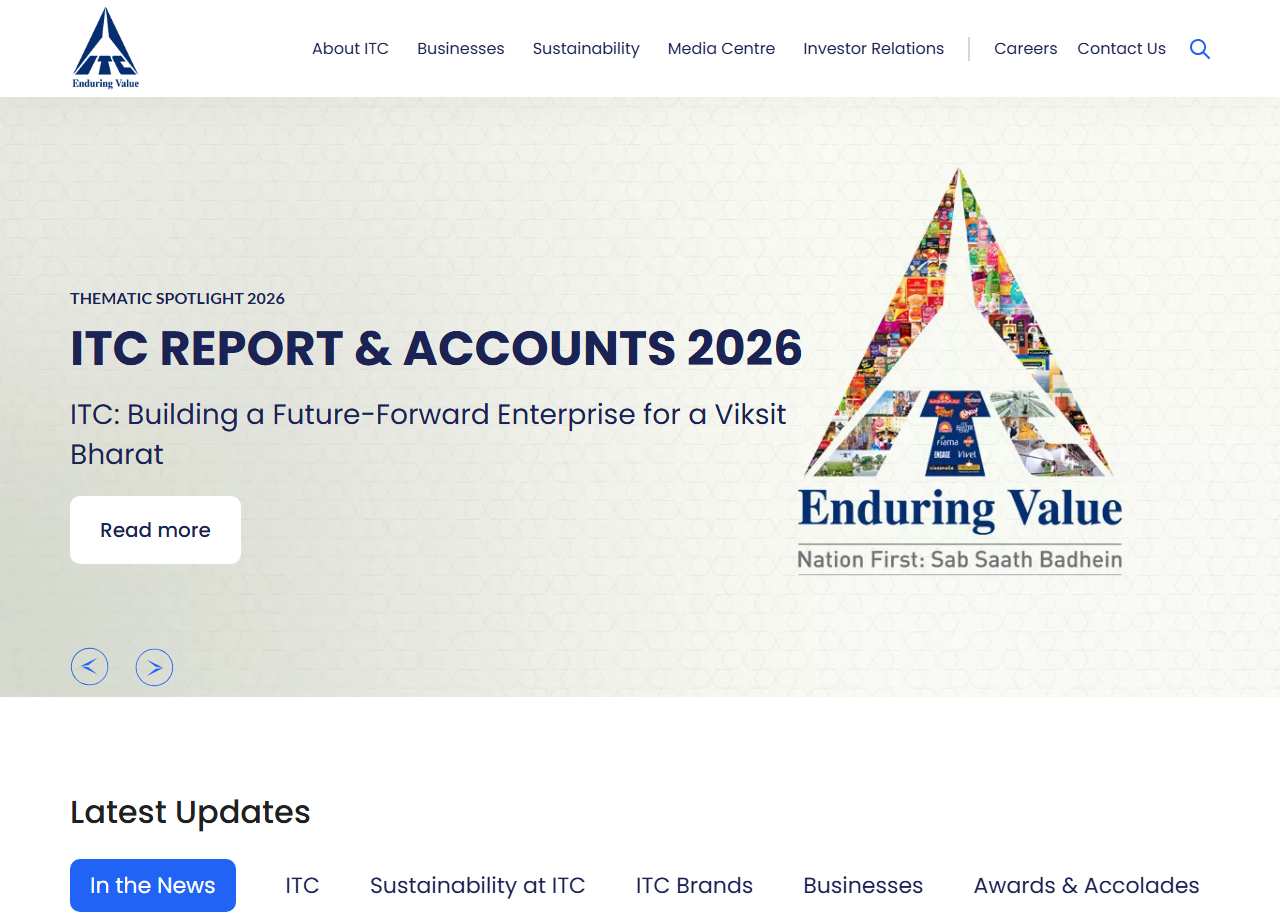
Evidence · itcportal.com homepage, captured during the audit run · unmodified full-page screenshot · the full artifact embeds 159 captures like this
01 · Central question
The one question that ranks above the rest
ITC's FY26 annual report reframes its auditors' report section by 39% year-over-year and reads with a confident, positive disclosure tone (net tone +4.81, modal conviction 0.66), while, outside that filing, ITC is cited in 0 of 4 buyer-intent AI-answer-engine queries (GEO score 0/100, verdict "invisible") and its own answer-engine readiness scores 13/100. Is leadership's confidence calibrated to the market ITC is actually discoverable in, or only to the market its filings describe?
Every finding below supports answering that one question, because it decides whether the next dollar of growth investment goes toward closing a real discovery gap or toward reinforcing a channel, paid media, that the emerging AI-answer surface is already routing around.
02 · Paid media, with the creatives captured
26 live Google ad creatives, read from the Ads Transparency Center.
The engine reads a company's advertising the way a competitor would. ITC Ltd. runs 26 live Google ad creatives (Google Ads Transparency, advertiser identity on record, region IN), and the capture below is the actual ad-library surface as the audit found it. Against that spend, the audit's PESO simulation models blended media cost at a directional ~$58,000/mo returning roughly $0 of incremental value per $1 spent, modeled and directional, from modelled CPC benchmarks, not ITC's books, and the dossier says so explicitly. The measured facts on either side of that model: 0/4 AI-answer citations and a 13/100 answer-engine readiness score.
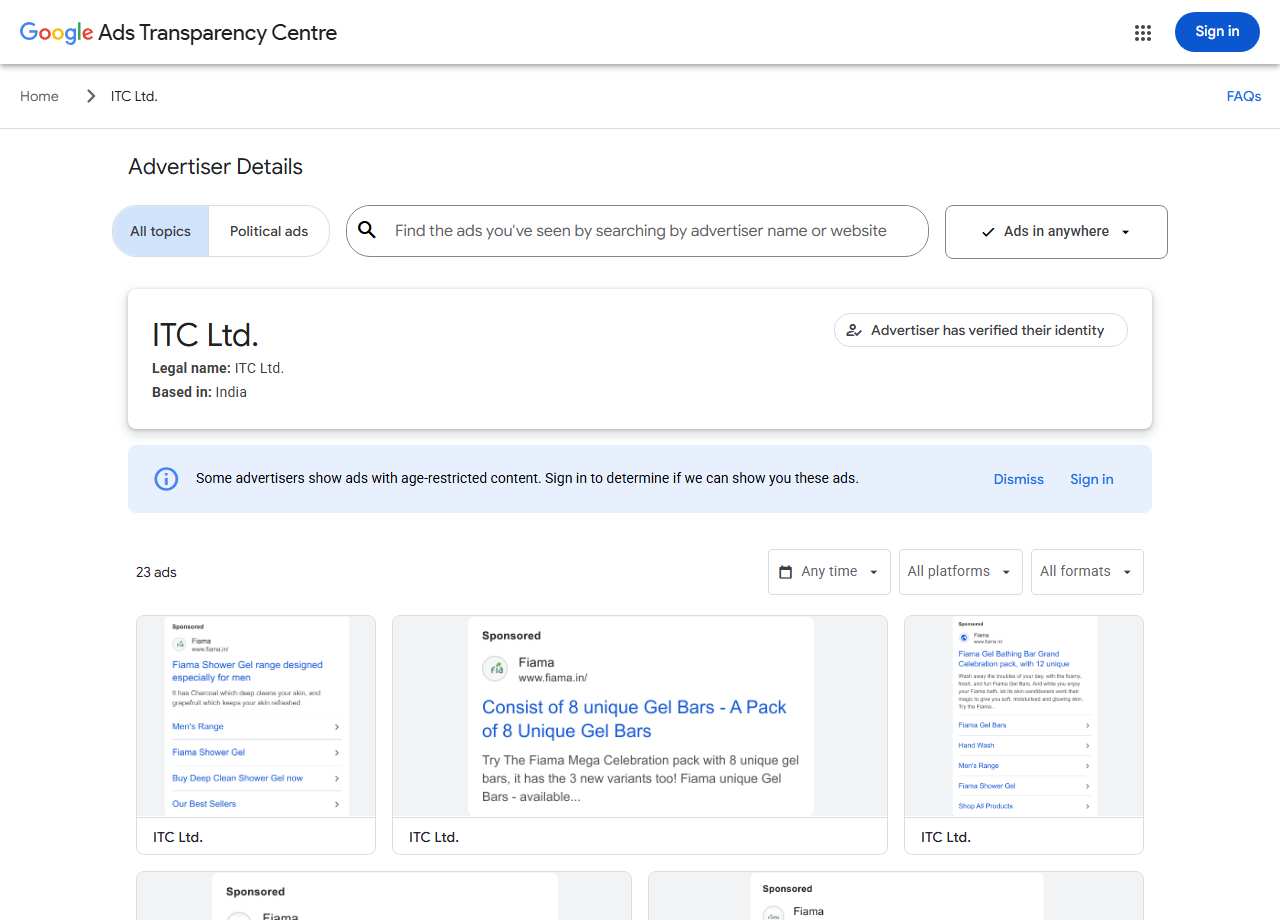
Evidence · Google Ads Transparency Center capture for ITC Ltd. (advertiser ID on record) · 26 live creatives at audit time · the full artifact renders these in the media-efficiency chapter as its ground-truth evidence
03 · Technical debt, itemized
Not one load-time number. A ranked, recoverable ledger.
ITC's real-user Core Web Vitals are healthy, CrUX LCP 1.51s, rated good, and the dossier says so, because a load-time number alone proves nothing. The debt that matters here is structural and itemized:
Technical SEO · 62/100
High severity. The top-scored technical-debt cause: H1 missing, meta description missing, zero FAQ/HowTo structured data, zero question-format headings, the exact machinery AI answer engines read. This is why GEO reads 0/100.
Trust signals
High severity. JavaScript console errors flagged on the live site by the audit's browser pass.
Unused CSS shipped
Medium. ~0.52s recoverable (lab), itemized by Lighthouse with the exact stylesheets named in the full artifact.
Unused JavaScript shipped
Medium. ~0.44s recoverable (lab), per-bundle breakdown in the full artifact's ranked-debt chapter.
The full artifact carries the reproducible Lighthouse evidence behind each line, category scores, the ranked-debt chapters, page-weight and script-work breakdowns, and the annotated homepage capture, so an engineering leader can re-run and verify every item.
04 · Forensic finding
A 39% reframe in the one section nobody rewrites casually.
The FY26 annual report's largest year-over-year disclosure shift is a 39% change in the auditors' report section, with net tone +4.81 and modal conviction 0.66, both reading confident and positive. It was filed the same period ITC's outside-in profile shows 0/4 buyer-intent AI-answer citations and a 13/100 answer-engine-readiness score. The filing's confidence is not addressing the external visibility gap this audit independently measures. That divergence, confident filing, invisible surface, is the finding.
05 · Economic stakes
What the gap costs, by year.
If true
If GEO invisibility persists while paid media is modeled (directional, PESO model) to return roughly $0 of incremental value per $1 spent, ITC's digital growth economics are quietly eroding in a channel the FY26 filing gives no indication anyone is watching.
Who loses
Marketing and growth budget efficiency near term; category-level enterprise value over time as AI-mediated discovery consolidates around competitors who are citable.
Year 1
Paid dependency continues at a modeled, directional ~$58,000/mo blended media cost with owned and earned channels not measurably closing the AI-visibility gap.
Year 2
AI-answer engines further displace organic and paid search referral paths ITC has not instrumented for, compounding the discovery gap this audit flags at 0/100 GEO.
Year 3
Category discovery consolidates around cited competitors; ITC's cost to re-enter that surface rises, unrecognized in a filing still centered on the auditors'-report reframing.
Range note
Every dollar figure above is modeled and directional, from modelled CPC benchmarks and a PESO simulation, not ITC's measured spend or books. Only measured are: GEO 0/100 (0 of 4 citations), AEO 13/100, technical-SEO 62/100, and the forensic 39% YoY disclosure shift. The dossier states that boundary instead of blurring it.
06 · Blind spots
What the outside-in scan can and cannot see.
What the audit CAN see
- GEO and AEO scores and the AI-answer citation test (0 of 4, measured).
- Technical-SEO and on-page audit: H1 and meta description both missing, zero FAQ/HowTo schema.
- Real-user Core Web Vitals: CrUX LCP 1.51s, rated good, stated plainly rather than replaced with a scarier lab number.
- The FY26 10-K year-over-year disclosure diff: auditors' report +39%.
- 26 live Google ad creatives via the Ads Transparency Center, identity-confirmed.
What the audit CANNOT see
- ITC's actual paid-media spend and true ROI; the audit holds only a directional CPC-benchmark estimate and says so.
- Any first-party AI-referral or citation tracking.
- Internal ownership of structured-data and AEO work.
Why it matters: the most consequential lever here, whether ITC is discoverable where AI-mediated buyer research is heading, is exactly the one an outside-in audit can only partially measure. It confirms the citation result; it cannot see the internal cause. The dossier draws that line instead of pretending otherwise.
07 · Leadership questions
Five questions to put on the next board agenda.
1
Do we track any AI-answer-engine referral traffic today, or is 0-of-4 buyer-intent citation actually invisible to us internally as well?
2
Is the FY26 auditors'-report reframing, a measured 39% year-over-year change, connected to any known commercial or disclosure risk, and does anyone cross-reference it against our external growth signals?
3
What is our actual, measured monthly paid-media spend and its true ROI, versus the directional $2,500-$112,500/mo range this audit had to estimate from industry CPC benchmarks?
4
If AI answer engines become a primary category-research surface, who owns building citable, structured content for them?
5
With technical SEO at 62/100 (the top-scored technical-debt cause) and answer-engine readiness at 13/100, who is accountable for closing the schema and FAQ gap?
08 · How the thesis could be wrong
Two ways to falsify our reading, and how to test them.
Assumption: ITC's paid-media spend and media ROI are close to the modeled -0.01x, ~$58,000/mo directional estimate in this audit.
Disprove by First-party ad-platform billing and attributed revenue showing actual spend and return differ materially from the modelled benchmark.
Assumption: GEO invisibility (0 of 4 citations) reflects a genuine, durable demand gap rather than a small-sample probe artifact.
Disprove by Re-running the AI-answer-engine probe across a larger, more diverse set of buyer-intent queries and showing consistent non-zero citation.
09 · The complete artifact
Read all 148 sections. Every screenshot. Both board simulations.
Everything above is the executive summary. The complete artifact is published below as it was produced, with two exceptions: one culture card is withheld because its quote came from the wrong company, and internal working notes are removed. It contains the GTM Health Index decomposed into its eight components, the ranked technical-debt chapters with reproducible Lighthouse evidence, the media-efficiency chapter with the ad-library captures as ground truth, the disclosure risk read, the cultural and narrative layers, the cross-company peer benchmarks, the per-metric provenance appendix, and both board simulations ending in the final verdict. 159 evidence screenshots are embedded. It is a 47 MB page because the evidence stays in.
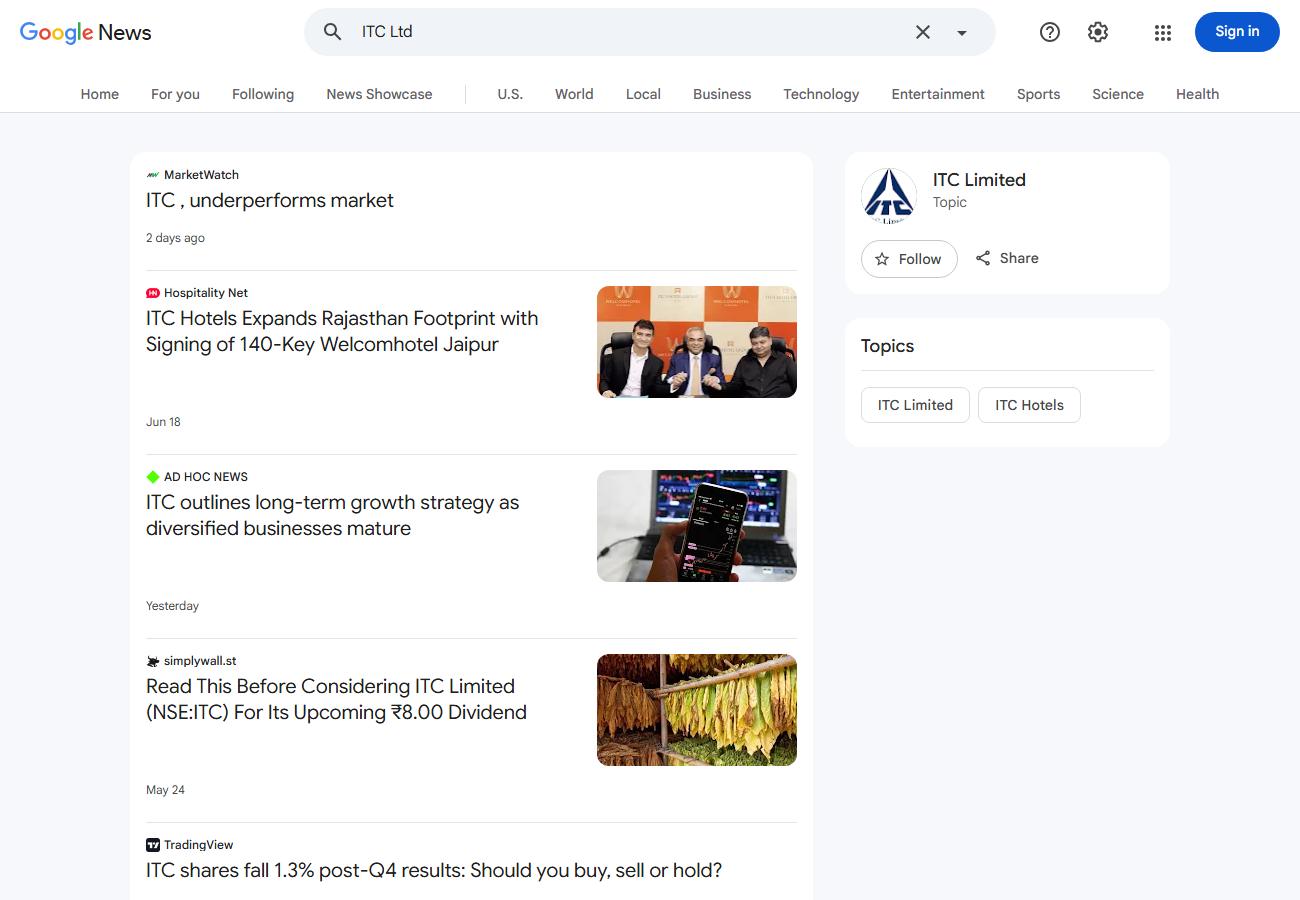
Evidence · news and earned-media surface capture · one of the 159 captures embedded in the full artifact
Evaluated boardReady = true · 87/100 (A) · 0 weaknesses · deterministic scoreBrief gate
Richness 98/100 (deterministic richness sweep; RICH band threshold 86)
Audit confidence 66/100 (solid) · stated, not hidden: some sources gated on this company; the dossier weights findings accordingly
Synthesis gold-harness 3-pass · draft · challenge · revise
Note This is a public sample, published in full. Every requested dossier is bespoke to the target company at this same depth.
Get this on your company — or a target you care about.
Same engine. Same evidence bar. One company once, with nothing renewing, or a company you live with on an annual term. Pricing is on request, and following a company in a free workspace costs nothing.